|
In terms of research I have interests that span atmosphere science to several disparate discipline areas within the geological sciences.
Project 1. Radar Precipitation Estimates
We have obtained a radar system for the TAMIU service area (Webb and surrounding counties, Texas). The acquired radar will be calibrated to more accurately reflect precipitation amounts through the use of "ground truthing" using data from weather stations strategically positioned throughout the service region for TAMIU forming a mesoscale network. Hence, we now have the capability to develop new algorithms for radar areal precipitation estimates from subtropical regions. Note that the two current algorithms available of mid-latitude and true tropical areas that are grossly inaccurate when applied to areas like South Texas.
top |
Website >>
Project 2. Surface and Groundwater Geochemistry.
I now have the capability of performing routine water quality analyses in the field. Analytical resources include a portable spectrophotometer as well as ion selective electrodes. Consequently, I am posed to initiate process-oriented geochemical studies of surface and groundwater systems. A previous example of such a study includes an in situ examination of the isotope geochemistry of a contaminated area Snake River Plain Aquifer (SRPA) at Test Area North, Idaho National Engineering and Environmental Laboratory (INEEL).
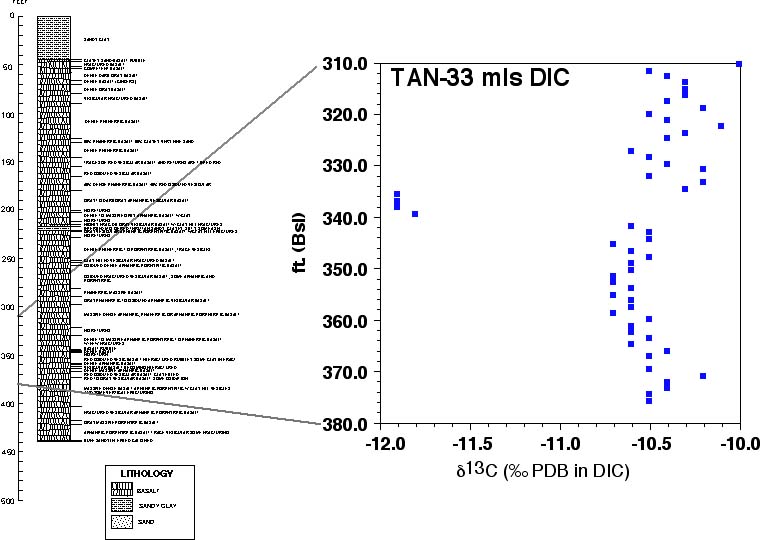
This figure shows depletion in 13-C at a rubble zone within the basaltic aquifer that perhaps is related to increased degradation of TCE (trichloroethylene).
Related Publication:
Tobin, K.J., Colwell, F.S., Onstott, T.C., and Smith R., 2000, The most recent calcite spar at the Test Area North, INEEL (Idaho): a possible example of contamination driven calcite precipitation. Chemical Geology. 169: 449-460.
PDF File
Funding Record:
Tobin, K.J., April 1999 to Dec. 1999, $31,760 (Subcontract), Control of biologically active degradation zones by vertical heterogeneity: applications in fractured media. EMSP (DOE).
top
Project 3. Environmental Microbiology
By combining microbiological and geological insights I have been able to develop a method that allows me to conduct bacterial incubations in the laboratory without addition of unrealistically high concentrations of organic carbon or nutrients to the incubation solution; a real breakthrough. Hence, it is now possible to evaluate microbial activities on lithic surfaces in the laboratory under conditions that are similar to those in the field. Additionally, my method has another advantage in that the bacteria are not removed from the petrographic context in which they reside.
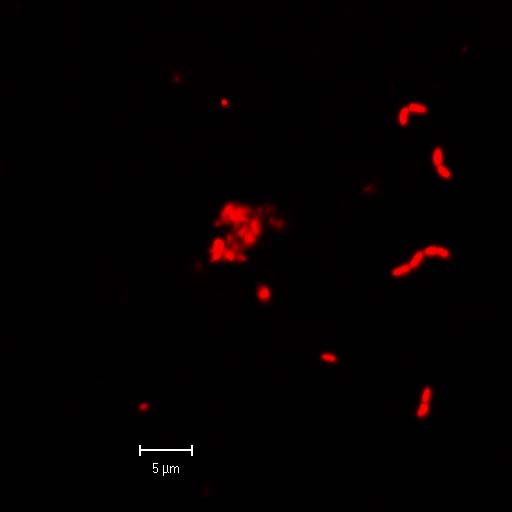
Yes there are cells growing on a basalt surface. Look at above nice confocal image of cells stained with propidium iodide (a nucleic acid stain) showing a microcolonies and dividing cells. Question? Where is the background fluorescence? Negative controls have 102 to 104 times fewer cells per square cm then samples inoculated in the environment and incubated in the lab, which typically have 105 to 106 cells per square cm.
Results presented at AGU in San Francisco in December 2000.
Related Publications:
Tobin, K.J.*, and Colwell, F., 2000, In situ visualization of viable biomass on subsurface basalt. EOS, Transactions.
Tobin, K.J., Onstott, T.C., DeFlaun, M.F., Colwell, F.S., and Fredrickson, J., 1999, In situ imaging of microorganisms in geologic material. Journal of Microbiological Methods. 37: 201-213.
PDF File
top
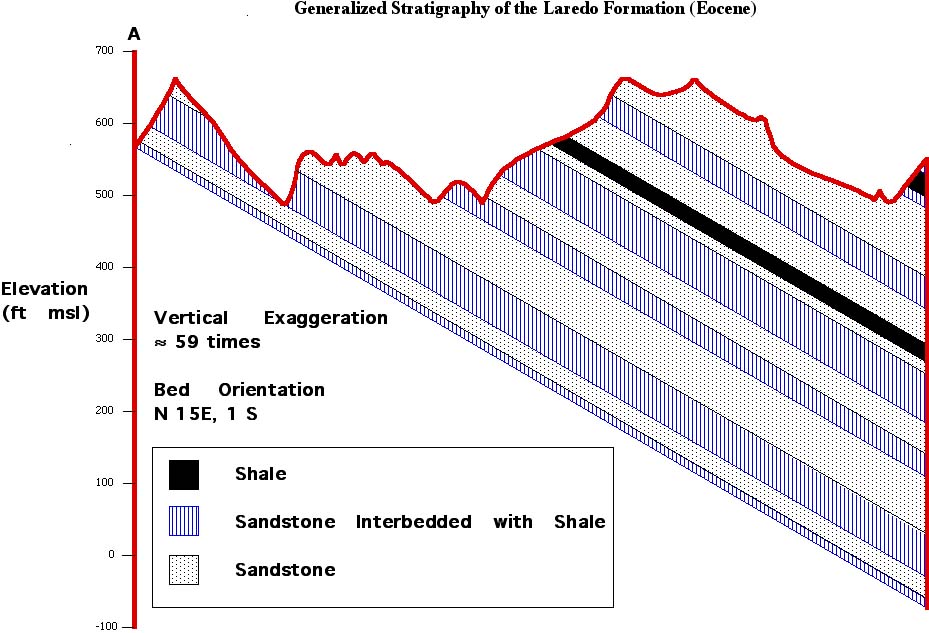
Project 4. Sequence Stratigraphy of the Laredo Formation
Initiating research examining the sequence stratigraphy of the Laredo Formation (Eocene)in South Texas - a marine-to-marginal marine unit. Sandstone deposits are aquifers and interbedded - shale units are the confining units so this work has relevance to the development of groundwater resources in the region.
top
Project 5. Carbonates
Have worked on a diversity of carbonates from Paleozoic limestone deposits to Martian meteorites to modern contaminated aquifers.
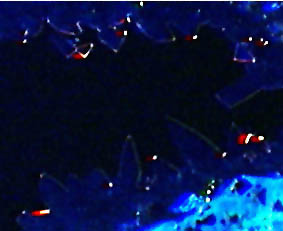
This is a cathodoluminscence photo. Basically, bright luminescence tips of calcite crystals formed recently (within last 50 years) within an anaerobic TCE plume in the SRPA. Pre-existing calcite is nonluminescent and formed during the past 1 Ma.
NOTE THAT THE SMALL AMOUNT OF OBSERVED CALCITE MATCHES (WITHIN AN ORDER OF MAGNITUDE) THE AMOUNT OF CALCITE CALCULATED TO HAVE FORMED BASED ON NETPATH MASS BALANCE MODELING!
Related Publications:
Tobin, K.J., and Driese, S.G., In Review, Echinoderm stabilization associated with a paleokarst at the Mississippian-Pennsylvanian boundary in Tennessee. Journal of Sedimentary Research.
PDF File
Tobin, K.J., and Bergström, S. M., In Press, Implications of Ordovician (˜ 460 m.y.) marine cement for constraining seawater temperature and atmospheric pCO2. Palaeogeography, Palaeoclimatology, Palaeoecology.
PDF File
Tobin, K.J., Fredrickson, J., Colwell, F.S., Smith, R., and Onstott, T.C., 1999, Recent calcite precipitation in a fractured aquifer waste plume: reconciling laboratory and natural microbial CO2 mineralization. 4th International Symposium on Subsurface Microbiology. p. 47
Vicenzi, E.P., Tobin, K., and et al., 1997, Carbonate in Lafayette meteorite: a detailed microanalytical study. Meteoritics and Planetary Science, 32: A132-A133.
Funding Record:
Walker, K.R., and Tobin, K.J., Feb. 1994 to Jan. 1997, $154,960, Isotopic composition of early diagenetic carbonate from the Ordovician: implications for greenhouse paleoceanography and paleoclimate and pre-vascular plant meteoric diagenesis. National Science Foundation.
top
|