TAMIU REU Site Expands Access to Engineering Research for Undergraduate Students

As universities continue expanding undergraduate research opportunities in STEM fields, the impact of a National Science Foundation (NSF)-funded Research Experiences for Undergraduates (REU) Site at Texas A&M International University (TAMIU) continues to resonate through student publications, international conference presentations and collaborative research achievements.
The TAMIU REU Site, titled “Gluing Computer Science and Convex Geometry: Research Experiences for Undergraduates,” was led by Dr. Habib M. Ammari, Endowed Professor of Computer Engineering in the TAMIU College of Arts and Sciences School of Engineering, under a $429,903 funding from the NSF.
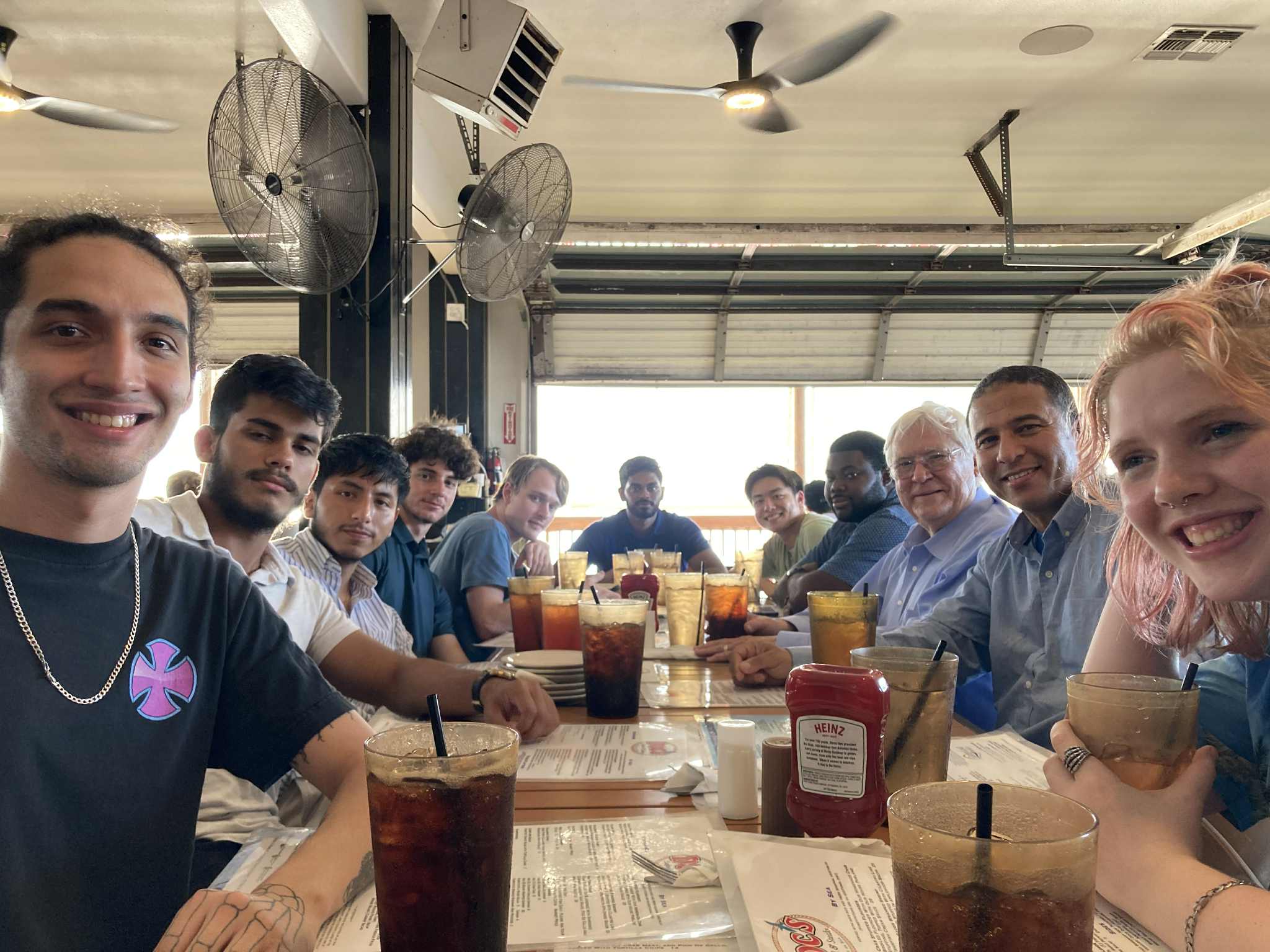
Over three summers between 2023 to 2025, the program focused on advancing undergraduate research in wireless sensor networks through an interdisciplinary approach combining computer science and convex geometry. Undergraduate students from universities across the nation engaged in advanced research projects with real-world applications.
REU Site students explored topics including wireless sensor networks, joint connected k-coverage, sensor scheduling, data gathering and delivery while working alongside faculty mentors in a collaborative research environment.
Ammari said the program helped expose underrepresented undergraduate students to advanced research opportunities while fostering collaboration with students from top universities nationwide.
“The TAMIU REU Site aimed at providing underrepresented undergraduate students with the research tools and experiences to be science and engineering statespersons for their generation,” Dr. Ammari said, "The program attracted participants from institutions including University of California, Berkeley, University of Florida, Rice University, Cornell University and Texas A&M International University."
The REU Site hosted 10 undergraduate students during each summer cohort, including participants at Texas A&M University-Kingsville in 2023 and 2024, and at Texas A&M International University in 2025. Participants received full support through the program, including weekly stipends, housing, meals and travel assistance.
Student researchers presented and published their work at conferences and academic venues around the world, including those in Greece, Peru, Belgium, France, Morocco, Japan, South Korea and Thailand. Several student projects also earned recognition through accepted conference papers, journal publications and research awards.
Many of the student-led research projects continue gaining visibility in 2026 through conference presentations in Switzerland, published proceedings and ongoing scholarly collaborations, underscoring the lasting impact of undergraduate STEM research opportunities.
Among the research accomplishments highlighted through the program were studies focused on energy-efficient k-coverage in wireless sensor networks, geometric inversion approaches to hole detection and restoration, deep reinforcement learning applications and optimization techniques for network connectivity. Students collaborated on projects that merged theoretical mathematics with engineering applications, providing hands-on experience in solving complex technological challenges.
Research conducted through the REU Site incorporated advanced mathematical and engineering concepts such as Helly’s Theorem, polygonal plane tiling and polyhedral space filling to address challenges in two-dimensional and three-dimensional wireless sensor deployments. The program also explored issues related to sensor heterogeneity and sensor irregularity and communication ranges in wireless networks.
The REU Site received two prestigious awards at the Institute of Electric and Electronic Engineers' (IEEE) PICom 2025 Conference, which took place in Japan in October 2025. One of the awards was for IEEE Best Student Paper Award and the other was for IEEE Best Paper Award.
As universities nationwide continue emphasizing experiential learning and undergraduate research, the outcomes of the TAMIU REU Site reflects the growing importance of collaborative STEM initiatives that prepare students for graduate study, innovation and leadership in science and engineering fields, Ammari said.
For more information, please contact Dr. Ammari at 956.326.3295, email habib.ammari@tamiu.edu or visit offices located in the Lamar Bruni Vergara Science Center, room 311.