TAMIU PhD Student Earns 1st Place for Poster Presentation at ACJS Annual Meeting
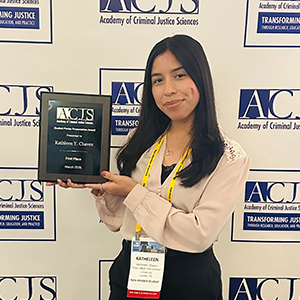
Texas A&M International University (TAMIU) Criminal Justice doctoral student Katheleen Chavez was recently awarded first place for her poster presentation during the at the Academy of Criminal Justice Sciences (ACJS) 63rd Annual Meeting in Philadelphia, PA.
Her poster, “Assessing U.S. Law Enforcement Training: Institutional Capacity on Terrorism and Hate Crime Preparedness,” focused on examining whether U.S. law enforcement training academies are institutionally prepared to address evolving threats in terrorism and hate crimes, she explained.
“Because local policing represents a foundational component of homeland security, preparing officers in these specialized areas is critical for early detection and prevention. Using national data from the 2022 Census of Law Enforcement Training Academies, the study applies Institutional Capacity Theory to analyze how institutional resources, programmatic priorities, and structural factors influence the availability and scope of terrorism and hate crime training within basic training curriculum,” said Chavez.
The study’s findings noted that most training academies offer terrorism and hate crime instruction. However, these topics are less prioritized over firearms, active shooter, and criminal law education, Chavez noted.
“On average, terrorism and hate crime training were about five hours of instruction, compared to approximately 40 to 70 hours for core training areas. Additionally, academies with accreditation and academic affiliations are significantly more likely to offer specialized training. These findings suggest that preparedness gaps are not random, but are shaped by institutional capacity, indicating that reform should focus on accreditation standards and curriculum mandates,” Chavez emphasized.
The ACJS Annual Meeting offered a shared space where scholars and practitioners from across the U.S. could share findings related to law enforcement preparedness for terrorism and hate crimes, while also facilitating dialogue, professional networking, and collaboration between researchers and practitioners.
It’s these opportunities that bring student research to life, reiterated Dr. Huseyin Cinoglu, TAMIU associate professor of Criminal Justice and Chavez’s portfolio committee chair.
“I sincerely believe student research matters because it is the point where students stop simply consuming knowledge and start producing it. For students pursuing advanced degrees, that shift is essential. It teaches them how to ask meaningful questions, work carefully with evidence, and contribute something of real value to the field,” said Cinoglu.
In Katheleen’s case, her project addressed a serious and timely issue in criminal justice and homeland security, emphasized Cinoglu.
“This kind of work shows exactly why graduate student research matters. It is not just an academic exercise. It helps students develop as scholars, strengthens their professional judgment, and, in many cases, produces findings that are relevant to policy and practice as well,” said Cinoglu.
The University’s Ph.D. in Criminal Justice Program is designed to guide students through an advanced, supervised course of study in criminology, crime, and the criminal justice system. As part of their academic study, graduate students focus on contemporary crime problems and the viability of potential policy and criminal justice agency responses to crime.
For more information on the University’s Ph.D. in Criminal Justice Program, visit https://go.tamiu.edu/phd-cj
More of the University’s story is available across its social channels on Facebook, Instagram, LinkedIn, Twitter, and YouTube. University news is also found on its dedicated NewsHub.
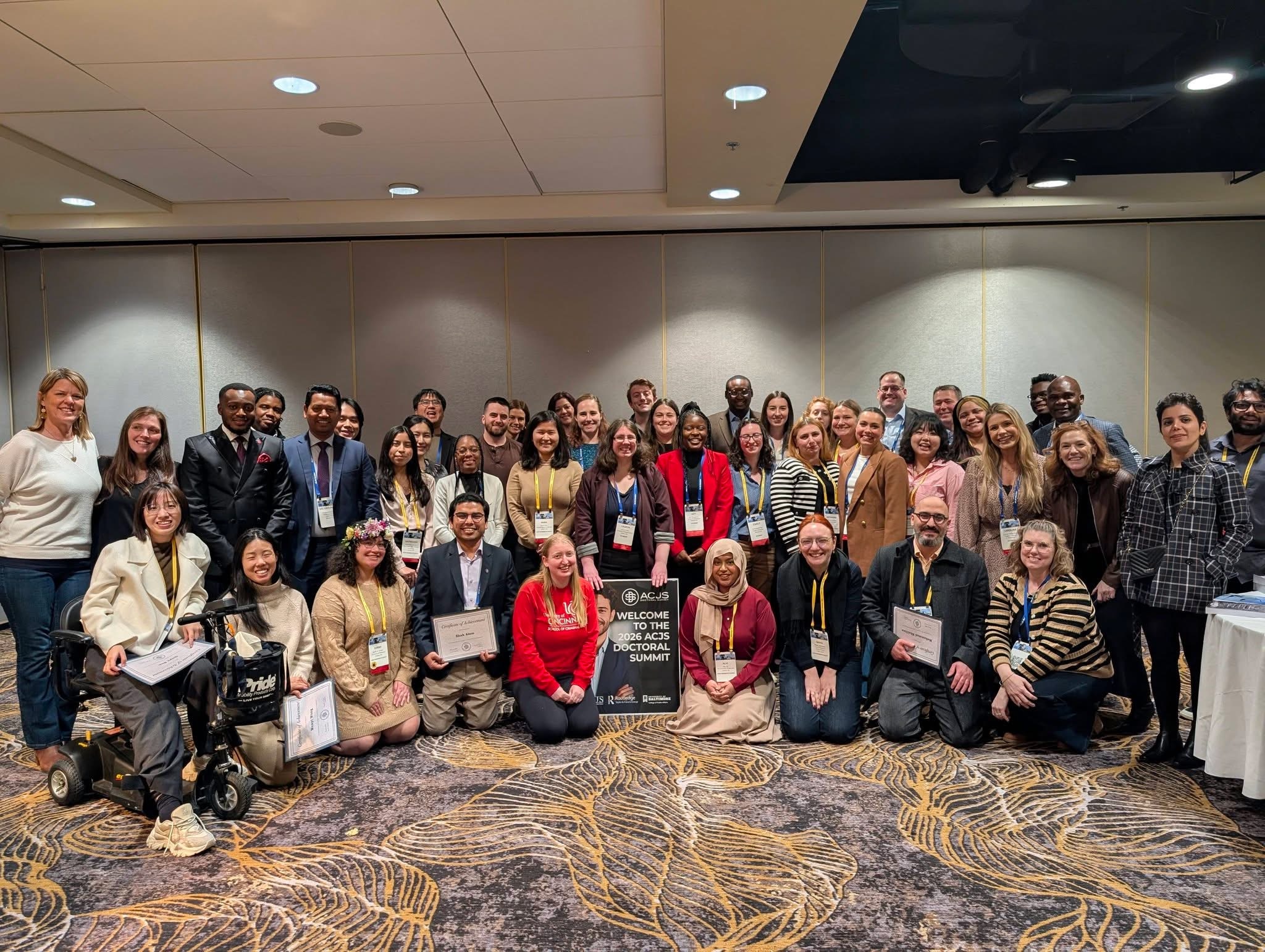
TAMIU Criminal Justice doctoral student Katheleen Chavez stands together with fellow doctoral students from universities across the United States during the 2026 Academy of Criminal Justice Sciences Doctoral Summit.