TAMIU’s Dr. Covarrubias Represents U.S.-Mexico Border at European Commission Global Debate
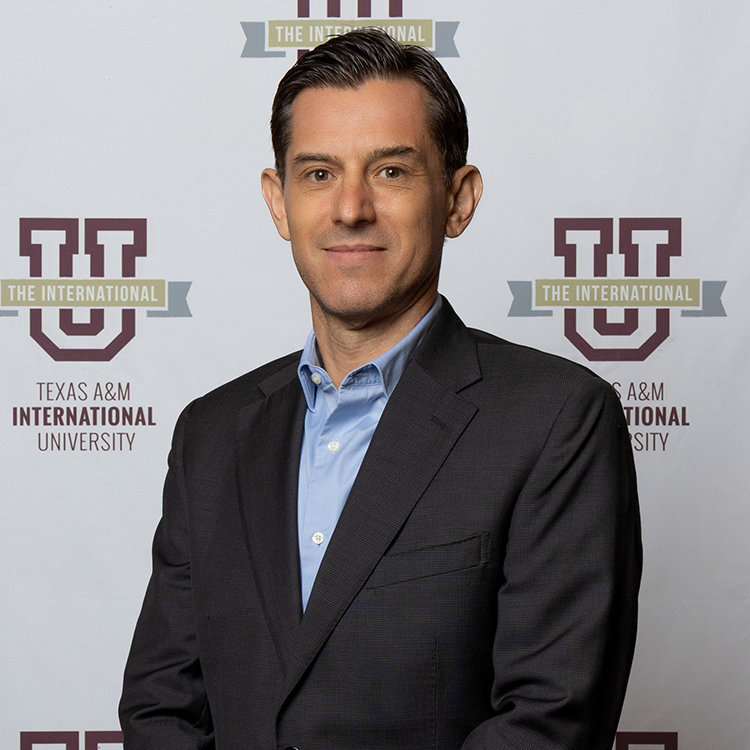
Dr. Daniel Covarrubias, director of Texas A&M International University's (TAMIU) A. R. Sanchez, Jr. School of Business Texas Center for Border Economic and Enterprise Development, represented the U.S.-Mexico border region at the European Commission’s 29th "Beyond Borders: Breakfast Debate" held recently virtually in Brussels, Belgium.
Covarrubias joined international experts from six border regions from five continents to discuss cross-border cooperation during the forum hosted in June by the European Commission’s Directorate-General for Regional and Urban Policy (DG REGIO) through its Border Focal Point Network.
The event, themed "Cross-Border Cooperation in the World," examined how border regions balance economic integration, security and international cooperation. Covarrubias joined experts representing the U.S.-Canada border, South America, Africa and Central Asia to share perspectives on the U.S.-Mexico border.
In his presentation, "Living Laboratories: Cross-Border Integration the North American Way," Covarrubias highlighted the Laredo border region as an example of deep economic integration. He noted that approximately $1.1 billion in goods crosses Laredo’s international bridges daily and that monthly trade through the Port of Laredo increased from $25 billion to $31 billion between January 2024 and October 2025.
“Trade grew through the tariff turbulence, not despite it,” Covarrubias said. “That tells you the integration is physical, not just paperwork. Components cross this border many times before a finished product rolls off the line. You cannot un-build that overnight, and you should not want to.”
Covarrubias also placed Laredo within the broader North American economy, citing $1.93 trillion in trilateral trade in 2024, a 136% increase in investment in new ventures since implementation of the United States-Mexico-Canada Agreement (USMCA), and an estimated 12 million U.S. jobs supported by the integrated North American market.
Addressing the upcoming 2026 review of the USMCA, Covarrubias said maintaining a unified regional framework will be essential to North American competitiveness.
“Some in Washington would trade one trilateral framework for three bilateral deals,” he said. “That means three rule sets and three certifications for a single product whose parts already move through all three countries. Fragmentation is slow and quiet, and it has a price.”
Covarrubias also compared North America’s and Europe’s approaches to regional integration, noting that Europe built its institutional framework before economic integration accelerated, while North America’s economy integrated first and institutions continue to evolve. He concluded by outlining three policy proposals developed by the Texas Center to strengthen continental competitiveness, including a joint U.S.-Mexico customs model, the proposed North American Industrial Coordination Council and the North American Digital Infrastructure Coordination Initiative.
“Borders are often described as the scars of history,” Covarrubias said. “They might better serve as living laboratories. The contrast between our borders is the point, and it is worth comparing notes.”
Covarrubias' participation in the European Commission forum highlights TAMIU's growing role in international discussions on border policy and regional economic development. It also brings his research on North American competitiveness, explored in his book, "Navigating the New Era of U.S.-Mexico Trade," to a global audience as preparations begin for the 2026 review of the United States-Mexico-Canada Agreement.
For more information about the Texas Center for Border Economic and Enterprise Development, visit texascenter.tamiu.edu, email Covarrubias at dcova@tamiu.edu or call 956.326.2520.