TAMIU's Dr. Covarrubias joins Mexican and Canadian diplomats at Baylor to weigh the future of North American cooperation
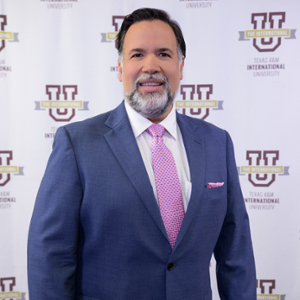
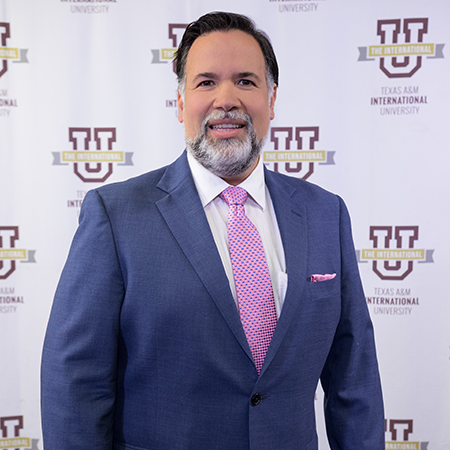
Dr. Daniel Covarrubias, director of Texas A&M International University’s (TAMIU) A.R. Sanchez Jr. School of Business Texas Center for Border Economic and Enterprise Development, spoke on “The Future of North American Cooperation” at Baylor University’s International Business Week in Waco on Oct. 28, 2026
Held at Baylor’s Hankamer School of Business, the session examined what the United States-Mexico-Canada Agreement’s (USMCA) move to annual reviews means for trade, investment and the border.
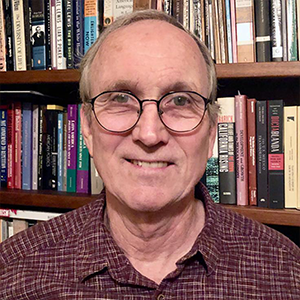
Moderated by Dr. Steve Gardner, professor emeritus of economics and international business at Baylor, the panel included Humberto Hernández Haddad, consul general of Mexico in Austin; Nelson Kalil, consul for political and economic affairs, Consulate General of Canada in Dallas; Dr. Michael Sposi, associate professor of economics and director of doctoral studies at Southern Methodist University; and Covarrubias, who brought his perspective on the U.S.-Mexico border.
The forum was organized for business professionals, public officials, members of the North Texas, Camino Real and Houston District Export Councils, and Baylor students and faculty.
The View From Laredo
Covarrubias opened with the scale of what's at stake. North America produces about a third of the world's GDP, and trade among the three countries has grown roughly fivefold since NAFTA took effect.
"I come from a place where $1 billion in trade crosses every day," Covarrubias said. "That happens because North America's supply chains grew together. The key going forward is keeping this a North American region. Separate bilateral agreements between the U.S. and Canada, the U.S. and Mexico, and Mexico and Canada would be a nightmare for any company trying to comply with all of them."
The Cost of Uncertainty
When asked how business is reacting to the USMCA’s shift to annual reviews after the July 2026 joint review ended without an agreement, Covarrubias said he would rather the three governments take longer and come out with a renewed 16-year term. Meanwhile, companies pay for the uncertainty.
"I've called it a precarity premium, and it's a tax on all of us," he said. "Businesses shorten their investment horizons, hold off on workforce development and pause investments until they know where the rules are going."
Covarrubias noted that in Laredo, some developers are taking a more measured pace on new warehouse and distribution space until the rules settle. He also urged the audience to read the U.S. trade deficit with Mexico with that integration in mind. "Before a finished good is done, it can cross the border seven or eight times," he said. "The goods coming from Mexico carry U.S. value, U.S. investment and U.S. worker hours.
Institutions the Agreement Still Needs
When Gardner asked each panelist what the agreement promises but hasn't delivered, Covarrubias pointed to institutions, noting, "The USMCA has institutions written into it, but they don't get funding or organization," he said.
Covarrubias added, "The North American Development Bank, born out of NAFTA and funded by both governments, shows what a truly binational institution looks like. The agreement needs more of that."
He cited the Binational Customs Agency, a joint U.S.-Mexico customs model he proposed with former Mexican Ambassador Gerónimo Gutiérrez Fernández in a white paper for the U.S.-Mexico Foundation, along with the International Boundary and Water Commission as a working precedent.
Covarrubias closed on an optimistic note, emphasizing. "The ingredients are all there," he said. "Mexico has a young population and manufacturing strength, the United States has the innovation and the R&D, and Canada has the natural resources. None of the three has everything, and together they can keep producing a third of the world’s GDP."
A Long Baylor Tradition
The panel continues Baylor’s long record on North American integration. In 1989, the university hosted "Region North America: Canada, the United States, Mexico," the first academic conference to consider a North American free trade agreement, and in 2005 it hosted the summit of President George W. Bush, President Vicente Fox and Prime Minister Paul Martin that launched the Security and Prosperity Partnership of North America.
Covarrubias thanked Gardner for the invitation, Lourenço Paz and the Hankamer School of Business for organizing International Business Week, and his fellow panelists for a candid exchange among all three USMCA countries.
For more information about Covarrubias's work or TAMIU's Texas Center research initiatives, visit http://texascenter.tamiu.edu or email Covarrubias at dcova@tamiu.edu.